
 Language
 English
 中文简体
 عربى
 Español

Bubble Material vs Embossed Fabric: Surface Structure Differences Explained
Oct 09, 2026Article Directory
A sourcing manager places two polyester swatches on the sampling table. One carries soft, pillow-like cells that compress under a thumbnail and recover slowly. The other shows a sharp damask motif pressed into a firm, flat base. Both are sold as textured fabrics, but the difference between bubble material fabric and embossed fabric is structural, not decorative: it changes washing behaviour, durability, cost and the final hand feel of an entire bedding collection. For an integrated manufacturer such as Changxing Fanxi Textile Co., Ltd., a polyester home textile producer that weaves and finishes in-house near Shanghai and Ningbo ports, this decision is driven by production data instead of first impressions.
Bubble material fabric and embossed fabric are defined by the direction of their surface construction: bubble material fabric, also called pressed foam fabric, builds convex cells upward by foaming and heat setting, while embossed fabric creates a recessed pattern downward when a heated engraved roller compresses the polyester surface.
Surface structure is the measurable distance between the highest and lowest points of the cloth face, expressed as relief depth. Buyers who can read that number make better sourcing decisions for bedding, curtains and apparel.
Surface Structure Differences at a Glance
The clearest structural difference is directional: bubble material fabric adds volume to the face of the cloth, while embossed fabric removes it by compression. One finish builds up, the other presses down, and every downstream property follows from that single difference.
| Characteristic | Bubble Material Fabric | Embossed Fabric |
| Surface profile | Convex, rounded cells | Recessed, sharp pattern |
| Typical relief depth | 0.5-2.0 mm | 0.3-1.0 mm |
| Reverse side | Slightly raised, uneven | Smooth, nearly unchanged |
| Hand feel | Soft, padded | Firm, denser |
| Typical weight range | 80-135 gsm | 80-140 gsm |
Sampling rule: if the texture is rounded, soft and visible on the reverse side, it is bubble material fabric. If the pattern is angular, crisp and the back of the cloth stays smooth, it is embossed polyester.
Production Process: Foaming vs Calendering
The production process explains the performance gap: bubble material fabric is foamed and heat-set on a prepared polyester base, while embossed fabric is shaped by a heated engraved roller that compresses the pattern into the surface of the cloth.
How bubble material fabric is made
- Weave or knit the polyester base, typically 190-320 cm wide at 80-120 gsm.
- Apply a foaming agent or foam layer to the face side of the fabric.
- Heat the fabric to 180-220 deg C so the foam expands into raised cells.
- Cool and set the cells so the relief survives cutting and sewing.
How embossed fabric is made
- Prepare a dyed or printed polyester base with even tension and moisture.
- Run the fabric through a calender fitted with an engraved steel roller.
- Apply 150-190 deg C heat and high linear pressure to compress the pattern.
- Cool the fabric on the exit side so the compressed areas stay fixed.
Because the bubble structure depends on a coating that sits above the yarn, it needs gentler care than an embossed surface. The article on polyester bubble fabric benefits explains how that coating behaves in washing and drying cycles.
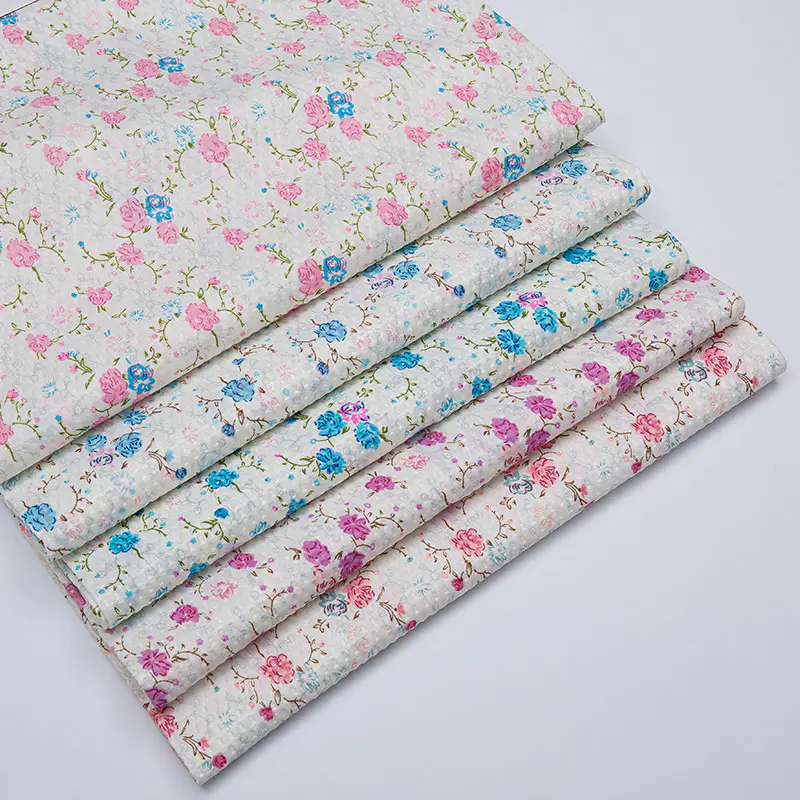 Disperse Printed Bubble-Textured 100% Polyester Fabric with Small Flower DesignThis polyester fabric features a raised bubble surface combined with disperse-printed small flowers, creating a three-dimensional effect. The bubble coating requires gentler washing than embossed patterns, making fabric care an important consideration.View Product →
Durability, Hand Feel and Care Compared
Embossed fabric keeps a sharper pattern through 50 or more wash cycles, while bubble material fabric delivers a softer, higher-relief surface that flattens faster under compression, heat and mechanical agitation.
Bubble Material Fabric
- Soft, padded hand feel with high visible volume
- Pattern is convex and catches light unevenly
- Cells flatten under pressure and lose height after many washes
- Lower abrasion resistance, suited to low-contact surfaces
- Requires cool washing below 40 deg C
Embossed Fabric
- Firm, smooth hand feel with a precise pattern
- Pattern is recessed and stays sharp over time
- Compressed areas hold their shape during washing
- Higher abrasion resistance for daily contact
- Tolerates standard machine washing up to 60 deg C
| Indicator | Bubble Material Fabric | Embossed Fabric |
| Pattern permanence | Moderate, 30-50 washes | High, 50+ washes |
| Softness | High | Moderate |
| Breathability | Moderate | Moderate to high |
| Drape | Soft, bulky | Clean, structured |
| Wash temperature | Below 40 deg C | Up to 60 deg C |
For bedding sheet programs where a soft surface is the selling point, a dyed microfiber embossed base at 85 gsm gives a smooth sleeping surface with a decorative pattern that survives hotel laundry cycles.
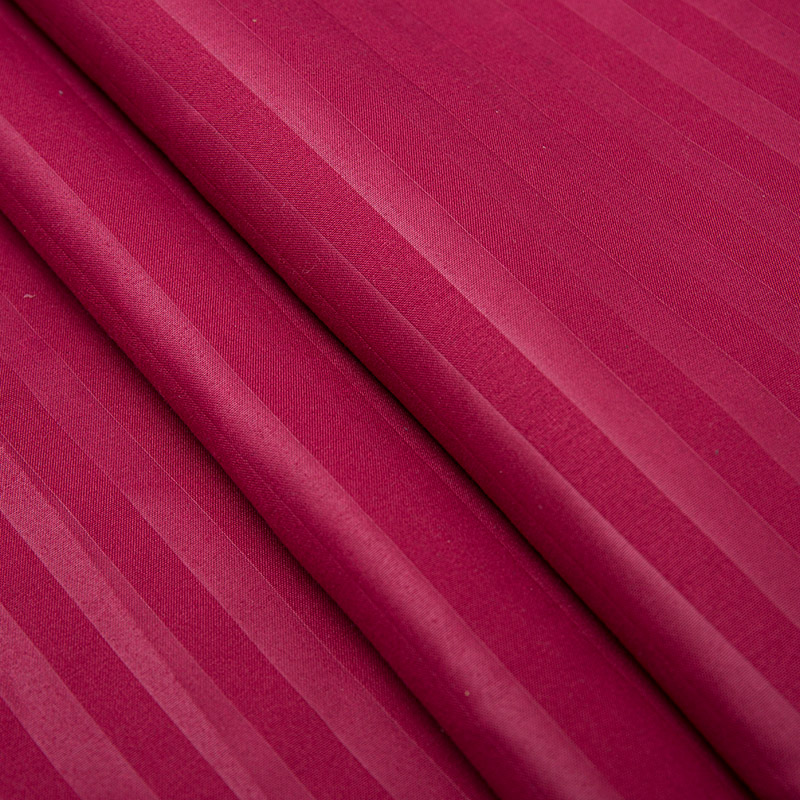 Dyed Microfiber Embossed Polyester Fabric for Bed Sheets, 250cm 85gsmDesigned for bedding, this 85 gsm microfiber embossed fabric offers a smooth sleeping surface with a subtle pattern that withstands hotel laundry cycles. Its elasticity and dimensional stability suit fitted sheet applications, though gentle washing is advised.View Product →
Sourcing and Application Fit
Sourcing the right finish comes down to three numbers: the base fabric weight, the loom width available for the order, and the wash temperature of the end product.
80-140gsm common order range
190-320cm loom width range
2.0 mmmax bubble relief depth
50+embossed pattern wash life
- Bedding sets and sheets: bubble material fabric adds quilted volume at 80-100 gsm; embossed fabric gives a smooth, cool-touch surface with a decorative motif.
- Curtains: embossed polyester holds crisp geometric or damask patterns and drapes with structure; bubble fabric suits padded or light-blocking panels.
- Apparel and lining: embossed fabric is preferred because the reverse side stays smooth against the skin; bubble fabric is rarely used next to the body.
- Upholstery and cushions: embossed fabric resists abrasion from daily use; bubble fabric belongs on low-contact decorative pillows.
An integrated factory can run both finishes on the same base constructions. That lets a buyer compare bubble and embossed options in the same weight, width and dye lot before committing to a full container order.
 Dyed Pressed Foam Home Textile Fabric with Customizable FinishesThis pressed foam fabric allows comparison with embossed options on the same base construction. Available in various blends and widths, it offers customizable stiffness, making it a versatile choice for projects requiring softness, volume, and visual warmth.View Product →
How to Choose Between Bubble and Embossed
Choose bubble material fabric when the design brief asks for softness, volume and visual warmth. Choose embossed fabric when it asks for precision, flatness and wash durability.
- If the product is a fitted sheet washed weekly, choose embossed fabric for pattern retention.
- If the product is a duvet cover where softness sells, choose bubble material fabric.
- If the pattern must match a brand logo or a geometric repeat, choose embossed fabric.
- If the goal is a padded, quilted look without an extra quilting process, choose bubble material fabric.
Before placing an order, ask the supplier three direct questions: what weight and width the loom can deliver, how the finish behaves at the wash temperature of your market, and what relief depth the production line can hold consistently across the entire batch. The answers will tell you which texture is right for the order.
Frequently Asked Questions
Is bubble material fabric the same as embossed fabric?
No. Bubble material fabric is built upward by a foaming and heat-setting process that creates convex, pillow-like cells. Embossed fabric is pressed downward by a heated engraved roller, which compresses the pattern into a flat polyester base. They share a similar base material but differ in construction, relief depth and washing behaviour.
Which fabric keeps its pattern longer after repeated washing?
Embossed fabric. The compressed areas are fixed into the fibre structure and survive 50 or more wash cycles at standard temperatures. Bubble cells lose height gradually under mechanical agitation, so they should be washed below 40 deg C to slow the flattening.
Can bubble and embossed finishes be combined in one bedding collection?
Yes. Many bedding programmes use embossed polyester for fitted sheets and pillowcases, where flatness and durability matter, and bubble material fabric for duvet covers and decorative pillows, where softness and volume are the selling points.
What fabric weight should I select for each finish?
For lightweight bedding and apparel, specify 80-100 gsm. For curtains, 115-135 gsm keeps the drape structured. An integrated supplier such as Changxing Fanxi Textile Co., Ltd. can run both finishes across a 190-320 cm loom range, which keeps weight, width and dye lot consistent.